Powered By Blogger

Saturday, 9 March 2013

Jambonneau de Poulet

Jambonneau de Poulet or stuffed chicken legs, is a simple dish to make and one where you can impress your friends or anyone else that may turn up unexpected and all with just a little knowledge on how best to butcher your bird.


Having checked my fridge and my larder, I've found a carrot, some asparagus, chicken & mushroom pate (coincidence) along with a tin of cream of chicken soup (another coincidence).
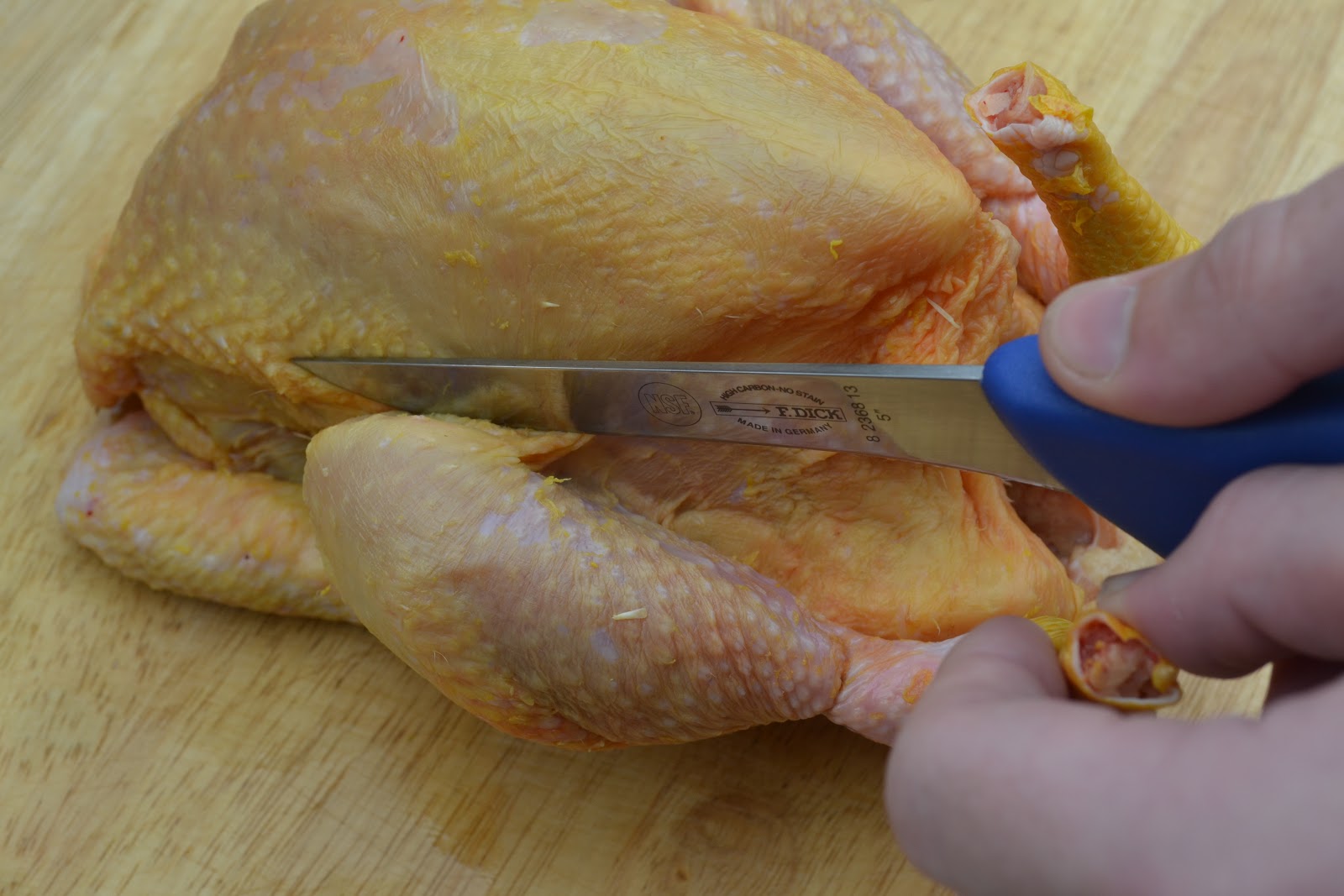
 
Having sorted my ingredients, I now need to portion my bird, here I'm using a small free range corn fed chicken. These birds not only look great with their yellow skin, they taste supreme too.
 

Place your boning knife in-between the thigh and the body of the carcass and draw your knife to the rear of the bird at the same time ensuring you cut through the ball & socket joint.

 
Once you have portioned the leg away from the carcass, you then need to bone out the thigh, ensuring you also take out the knee cap.
 

Then with a pair of poultry shears or a heavy knife, cut off the lower leg above the joint.

 
Tidy up any areas where sinews may potrude along with any loose attached pieces of skin.


Once you have done this, place your thumbs inside the cavity of the drumstick and push the bone until it potrudes out of the small open end.


Now place some filling into the space where the thigh bone had been along with some sitting tight up behind the drumstick bone. Here I've used some chicken & mushroom pate, but you could use some paxo stuffing or perhaps some sausagemeat, the choice is yours.


Having filled your chicken legs with your filling, place the joint inside a muffin mould or similar. Arrange so the joints sit like a pear inside the mould, if you don't have any muffin moulds then use an empty soup can like the one pictured below.


It is best that you wrap some cooking foil around the potruding bone whilst cooking as this will stop the bone turning black and unattractive. Cook for approximately 30 minutes at 180c degrees or until the juices run clear.

 
Once the joint has been cooked, allow the meat to rest and then proceed to slice a good piece or two off the base and then sit the main section down flat on your plate to look like a pear, add the extra slices and arrange nicely. Here I added some steamed vegetables and then finished it with the creamy chicken & mushroom soup as my sauce.
 
The preperation time for this Jambonneau dish was only 20 minutes including the butchery. The cooking time was 30 minutes with additional 10 minutes meat resting time, the whole dish from start to finish was only an hour.
 
 
Why don't you give this dish a go and broaden your butchery skills...
 
By the way, it was just a coincidence that my friends turned up with some white wine ;-)

Wednesday, 6 March 2013

Ham Hock Terrine

Theres something really sublime and special about making your own homemade Ham Hock Terrines, they offer class and at the same time they are a household classic. Using the cheap cuts of a pig offers a certain feeling of satisfaction that you are making the most of nose to tail eating thus respecting the pig to very end.


So simple to make, here I've put 4 large ham hocks in a large stock pot together with some pork stock I had made earlier. You could use a vegetable bouillion and a bouquet garni of herbs if you so wish or maybe some local cider, the choice is yours. Two large ham hocks will fill a terrine the size of the one pictured below.


Slow cook for approximately 3 hours or until the meat starts to fall off the bone. Then decant the hocks from the stock and pare the meat away from bones and skin. In a large mixing bowl season the meat to taste if required and then start to add some off the gelatinous stock back to the meat until you reach your desired consistency.


Layer your terrines first with some clingfilm and then the meat to about halfway, then place your desired added ingredients to complement the terrine, here I've added pickled cornichons and some silverskin onions. You may prefer to add a nice bright yellow piccalilli or a wholegrain mustard. I usually add a glug of sherry vinegar at this stage just to help cut through the gelatinous meat.
  

Complete the layers until the terrine is full and then place a piece of wood or cardboard as I've used here and placed in a plastic bag on top of your terrine. Then place some weights on top and place in your fridge for 24 hours to set.

 
Alternatively use a round terrine and place a small plate on top with some weights to help set your terrine.
 
Once your terrine is set, decant onto a larger plate and remove the clingfilm and place in the centre of a table for all to see and admire.
 
 
I've served a wedge of the terrine here along with some wholegrain mustard, caper berries, silverskin onions along with a pickled egg and rye bread.
 
 
Why don't you pop down to your local butchers and ask for some ham hocks and make yourself a ham hock terrine today.

Thursday, 21 February 2013

Colonial Goose

What is Colonial Goose I hear you say? Well I can tell you it's been around for many years, in fact it goes back to the colonial days when the early British pioneers were some of the first white settlers to reach New Zealand. On the menu was mutton mutton mutton and the few eateries that were around then decided to re-vamp their menus and entice their customers with a new dish called Colonial Goose. This new dish was actually mutton dressed as a goose as it was easy to bone a leg or shoulder of mutton and then tie it to resemble the geese that the pioneers were missing from back home.

 
You can use either a leg of mutton or a shoulder of hogget as I've used here. Start by removing the shoulder blade along with the humerus bone from the inside of the shoulder. Once the bones are removed, fill the cavity with a stuffing, traditionally honey and chopped apricots were included as they were plentiful, once stuffed tie the joint to secure the stuffing and also to help keep the shape of the goose, pinning the knuckle bone with a skewer will give it an upright swimming appearance.


In order to get a silky brown colour to the joint, it would be marinaded in red wine thus taking on the rich colour of a real goose. Personally I would cure my joint in salt for at least 3 weeks before butchering and stuffing as this imitates the goose better than just using a wine marinade.


I prefer Colonial Goose cold and sliced thinly served with chutney and bread, but you can eat it warm with vegetables and lashings of gravy if you wish. Which ever way you choose to eat this dish I'm sure you will enjoy it and it will be a talking point amongst your family and friends.

Tip: For the professional butcher / chef; I cured this joint sous vide for 3 weeks using between 30g-40g of curing salt per kilo of meat. Afterwards I take out the joint pat dry with paper towel and then re-pack in sous vide along with a few herbs a little lemon zest and cook at 71c degrees for 3hrs and then leave in the bain marie until chilled.

Voila !

Try it and let me know what you think guys...

Tuesday, 19 February 2013

Oyster Shucker

I've lost my trusty oyster shucker, I can't find it anywhere.


Albeit I do use it to open oysters from time to time, of coarse that it what it is designed for.


However I use it on an almost daily basis as a butchery tool.


Removing wisbones from chicken with it, makes work a lot easier.


Best of all it is the best tool to use to clean the bones on a rack of lamb.


Some tools designed purposely for a task, accidently find a better use elsewhere.


Albeit the shucker is the best tool for cleaning bones, I'll just have to use a knife until my oyster shucker is either found or returned by someone who has borrowed it and hasn't as yet returned it to it's proper place.

I know who you are......

Friday, 8 February 2013

Lamb Butchery with the Flockable Lasses


I first met Sophie one of the two www.FlockableLasses.com  via Twitter, she kindly remarked on my charcuterie and expressed how she one day would like to learn those very skills that I had recently posted about, including on how to make a lamb cushion from a shoulder of lamb.


Well a week or two passed and I had followed Sophie during this time and all that I had witnessed was a young lady and her friend trying very hard to break out into Farming along with helping to save some rare & traditional breeds of sheep. These included the Castlemilk Moorit and Whiteface Woodland breeds and I know she would like to have some Herdwick sheep too within her present flock.

This determination along with her polite manner and comradeship with her friend Annabelle made me think if only they could get a little help from people that can offer it, they could become a formidable team that could inspire the next generation. That's it, my mind was made up, I had decided I would offer her and her friend free butchery and charcuterie training for a whole year. This is December 2012, so I decided to wait until Christmas before informing Sophie of my offer. I followed her on Twitter and witnessed through her tweets her commitment to farming. She was often by herself working through the cold nights delivering lambs into this world whilst the rest of us were tucked up in a warm bed. Well Christmas Eve was upon us and Sophie once again was working nights in the Lambing Shed by herself, she would be breaking in Christmas Day in a cold dark barn with no-one to talk to other than the sheep and as any sheepish events unfolded she would tweet them to the outside world for the rest of us to read in the comfort of our homes. On this occassion and just after midnight I emailed Sophie with my offer, this automatically transferred to her mobile phone and she received it whilst in the lambing shed working (not that I knew that would happen).

Sophie later told me she had become emotional and that my offer of help was the best Christmas present she could of wished for and that she would accept my offer along with her good friend Annabelle.

Well folks here is a video the lasses made recently of their first butchery & charcuterie lesson and if you can offer them any help at all with their Farming career do get in touch with them, for they are our future and we need them to succeed for the benefit of us all...

Just like to say a huge Thank You to Sally of www.empirefarm.co.uk for allowing us the free use of her butchery department.

p.s. Sophie, Empire Farm is in Somerset not Dorset....Lol

Monday, 28 January 2013

Wagyu Beef Dripping

Recently on Twitter I mentioned about cooking some Parsnip crisps in dripping and how wonderful they tasted. www.alternativemeats.co.uk chipped in and mentioned about one of their products a beef dripping made from Wagyu beef fat, this developed into having some delivered for me to sample and to share my views.


From left to right dripping products from: Amko, Powderham Farm Shop, Highgrove, plus a Pork dripping on top from Andy Allens (found at my local butchers), 2 silver trays of Wagyu dripping and a 500g block of dripping on top from Nortech (found at cash & carry).


Other companies including www.amko.co.uk did the same and I also took a trip around my local shops including my local butcher, farmshop, supermarket and cash & carry to see what they had for me to purchase and test making a comparison against this Wagyu dripping. I'ved used Amko products before and I know them to be of good quality in particular their Beef Suet made from the fat that surrounds the ox-kidneys. Having their dripping in my small collection of fats will set a standard I recognise and can compare against the Wagyu dripping and the others I purveyed.


I carried out some very scientific tests (only joking) to start my comparisons of the dripping, firstly was toast & dripping, frying of croutons, frying of potato slices and some Yorkshire pudding. These simple tests tell me quickly what dripping has the best taste results when used against other ingredients that are normally bland in their own right.  
 
 
In all my tests (layman style) I found non of the drippings to be a real dripping in the strictest sense i.e. fats taken from cooked meats (except for the pork dripping which had a clear divide of fat and cooking liquor at the bottom of their container, in Yorkshire they would call this "Mucky Fat") Instead they were all rendered fats and of which lacked the strength of beef taste you get from traditional dripping.  
 
All said and done the drippings were mediocre to good except for the top 3, not that this is a competition just someones thoughts on these products (mine). Third place for me was the dripping from Amko, then second place and probably my favourite overall was the dripping from Highgrove (childhood memories evoked by its full beef flavour), then came the clear winner
 (drum roll************* please)....... the Wagyu Beef Dripping. 
 
Welsh Wagyu Beef Fat
 
So how did I come to choose the Wagyu Beef Fat over the other drippings you may ask especially when I favourited the Highgrove version. Well the Highgrove one did taste very much like a true dripping with its full beefy flavour and reminded me of my childhood. Fond memories of times past when as a family we had no money but we had bread and dripping. I can only guess the Highgrove version is Organic and the cattle are grass fed thus offering this great flavour. Lets talk about the Wagyu, I have to say in all my years I've never tasted beef fat as good as this before, it is velvety or even silky to use, the flavour is subtle and it just exhudes quality when you use it. Forgive me for what I'm about to say, but I think it's too good to use in the conventional way, so having said that, how do you best use it?

I personally think it's best used in bespoke bakery products or perhaps blended with some Wagyu marrowbone and butter to make Wagyu Marrowbone Butter Rolls and then to slice and use as a garnish to the magnificent grilled steaks this animal produces.
 
Whatever you decide is the better dripping to use, I'm sure we will all agree that any dripping from any animal is a solid track to a good ethos of nose to tail eating.
 
Average Dripping Prices :
 
Nortech =                           £  1.40 per kg
Powderham Farm Shop =  £  7.50 per kg
Highgrove =                       £  4.00 per kg
Amko =                              £  3.00 per kg 
Wagyu =                            £ 66.00 per kg

Why not try some dripping next time you make some Spotted Dick or Hot Cross Buns, you know it makes sense and you are helping to keep our food heritage alive.


Tuesday, 1 January 2013

Christmas Birds

Searching for a bird for Christmas started early in December for myself, I could of easily bought a bird from my local producer, but this time I wanted to see first hand the healthiness of our livestock markets.

My first trip out was to Melton Mowbray Market in Leicestershire, this was my first visit to this market.


This market is right in the town a small to medium size market with a rich variation of auctions including food stalls, antique and bric a brac, beef, sheep, pig and a poultry market with both live birds and dressed poultry along with a very active game market.


Next market I visited was Ross on Wye, this is a market I've visited many times when I used to live in Herefordshire, so I was really looking forward to returning to this little market and the town for some Christmas retail therapy.


Here we have a local farmer bringing in his turkeys to be sold by the local auctioneer.


The livestock show ring was full of dressed birds and here we can see the auctioneers listing all the birds whilst examining they are fit for sale and the best of them being awarded a First Prize certificate.


All the dressed birds have to be bagged now for display and for the sale as this is part of the good practice being enforced. However I did wonder will the birds sweat in these plastic covers and spoil, I think not for most people tend to understand that on getting your bird home you should then unwrap your bird and allow it to breath. Ensuring you cook it thoroughly and soon after purchase is a safe guard we must implement.


Before the sale starts, all the visitors can inspect the birds and choose one with which they want to bid on when the auction commences.


This sale had the best of all the birds I've seen so far and the prices reflected that when the bidding commenced. The geese were fetching as much as £75 each, the Cockerels £38 each, Ducks £33 each and Turkeys averaging £44 each. They were very good birds, well dressed and fault free of any other kind that I could see.

 
Now I'm at Sedgemoor Livestock Auction near Bridgwater in Somerset and they were birds laid out as far as you could see into the distance.
 

There were some good quality birds here to see, especially the cockerels, however the general overall lots were poorly dressed, including the long legged birds which apeared to have been dead far too long.


These Stag or Tom Turkeys pictured below looked some of the best on sale and yet they were only fetching around £1.50 llb a very poor price for the farmer given these birds were free range and sometimes organically reared.


Can anyone tell me why Stag Turkeys have this little wire brush on their throats? (I know the answer, but do you?)

Well I had a goose this year for Christmas a big one weighing 5.5kg making our Christmas meal special, it also kindly fed us on Boxing Day too and we had a curry the day after that with the rest, also I have a a 2ltr jar of goose fat to use in cooking over the coming weeks.

If you are not in touch with a local producer for your poultry then I urge you to visit and try out your local livestock auction when they next have a sale. It is a magical experience and one you can share with all members of your family.