Powered By Blogger

Tuesday, 28 September 2010

Bacon Roly Poly

Bacon Roly Poly or Jambon en Croute, no matter what you call this dish you will enjoy it's simplicity.


I use ready made pastry, either shortcrust or puff pastry, the results will be same using either.


Unroll your pastry, this can be round as displayed here, however using oblong would be better.


Having unrolled your pastry, then scatter some dried sage over your pastry base.


I photographed this dish outside to get the best of the daylight, however the wind kept blowing away my sage.

Place rashers of streaky bacon on top of your sage and pastry.


Now having sliced some onion, place it on the bacon.


Now roll up your pastry and its contents.


Roll the parcel in the pastry blue wrapping and once more in a tea towel.


Tie off the ends with butchers twine.


Place your roly poly in a stock pot or large marmite, cover in water and simmer for at least one hour before adding some root vegetables and cook for another 2 hours.


This dish can be cooked on a campfire, in the oven or on top of the stove. When the dish is ready you can unwrap your roly poly and slice along the length giving you nice attractive portions. At this stage with my excitement of eating this dish I forgot to take any further pictures. This dish does require a nice sauce or gravy to add colour to the dish as the finished pastry looks too pale without it.

Tuesday, 21 September 2010

Pork Pie

This pork pie recipe is probably one of the best you will ever find, if you plan on changing any part of this recipe, I suggest you alter only the seasoning of the meat to suit your palate, the hot water pastry should never be altered.


Pie Filling
1.5kg x Pork Mince for an 8inch round pie mould or several smaller ones.

200g x Bacon minced or 12 x Anchovies crushed

1 x Teaspoon Salt

1 x Teaspoon White Pepper

¼ x Teaspoon Mace


Hot Water Pastry
100g x Lard

100g x Butter

200ml x Water

2 x Teaspoon Salt

2 x Eggs

1 x Egg Glaze

550g x Plain Flour


Sieve the flour and add salt and 2 eggs, mix together and make a well in the middle for the liquid mix.

Slowly melt butter and lard in the water, do not boil,add to the pastry mix and bind together, now cover and store for 4 hours to cool or better still overnight but not in the fridge.

Work your pastry at ambient temperature for this makes hand raising easy to apply. Once you have raised your pastry within a pie mould, place your meat firmly inside avoiding any air pockets, place a pastry lid on top and crimp. Brush your pies with an egg wash before placing them in a hot oven at 180c for 20 minutes then reduce the heat to 160c for a further 1 hour. If you have used pie moulds then out turn 15 minutes from the end and brush with egg wash once more, then finish the baking by returning them to the oven for the last 15 minutes. Allow your pies to cool on a trivet or cooling rack before filling with gelatine.

Tip: Do not use any substitutes, only use real butter, lard and free range eggs. Always top up your pie with gelatine for this dispels any air held between the pastry wall and the shrunken cooled meat and by doing so it will help you to achieve a shelflife of approximately 10 days. Using bacon or anchovies will achieve a cured pork pie mix thus also helping the shelflife and offers a slightly deeper flavour, if an uncured pork filling is required, then leave these ingredients out, just remembering the shelflife of the pie will be shorter.

Sunday, 19 September 2010

Dig for Victory!

At a time of year when we remember those from our past and in particular those in war time, lets share a thought for those who helped to feed us!


At the going down of the sun and in the morning "We will remember them".

Thursday, 16 September 2010

Organic Meat Awards

Congratulations to yet another small business I have been training recently, Higher Hacknell Farm in North Devon have recently won an award from the Soil Association Organic Food Awards 2010. Jo and Tim budden who started their business back in 1985 attended the awards ceremony recently in Bristol where they were presented with their award by Hugh Fearnley-Whittingstall.


Also recently the farm won a Silver Award from The Taste of the West Awards for their salted beef which we worked hard on to create the right recipe along with using prime beef from their herd of South Devon Cattle.

Well done to Jo, Tim and Keith the butcher.

www.higherhacknell.co.uk

Wednesday, 1 September 2010

Back Soon!


Phew! Wow! I'm shocked, you know when I started this blog in conjunction with tweeting on Twitter, I had every intention of only supplying a post for each day for the following twelve months.

Today having been spotted on Twitter, I have been commissioned to write a cookbook with the option on a series, all this and yet I have only been tweeting for a few weeks, I had no idea that the power of Twitter could bring such rewards. I also had no idea that my talent as a Boucher-Charcutier-Traiteur would be so interesting to so many.

My registered followers are few and yet behind the scenes my statistics show that the readers are so many including people from Asia, mainland Europe and the USA.

So with this news, forgive me whilst I take a break from blogging. I can promise you I will return as soon as I can to share with you how it all happened.

Regards
Marc-Frederic

Tuesday, 31 August 2010

Galantine de Poulet

Galantine de Poulet sounds so much nicer than Boned & Rolled Stuffed Chicken don't you think? Still not many people know that the word galantine is an English word, galantine is a dish where it is boned and rolled and cooked by poaching, unlike a ballotine which is baked, that is the only subtle difference.

There are a lot of pictures here I'm afraid as they are several techniques that need to be explained or demonstrated. Don't be put off by the work involved in preparing this dish, it will take you approximately 45 minutes for your first attempt and after a few practise goes you will get this down to 15 minutes.


Turn your chicken upside down so the breast is facing down and take your knife and make an incision from the neck all the way through to the tail.


Carefully cut around the rib cage and lift the carcass out when possible.


You can at this stage cut off the wings and thighs or bone them out too, like I've done here.


Gently pound and flatten the breast meat to make for easy rolling.


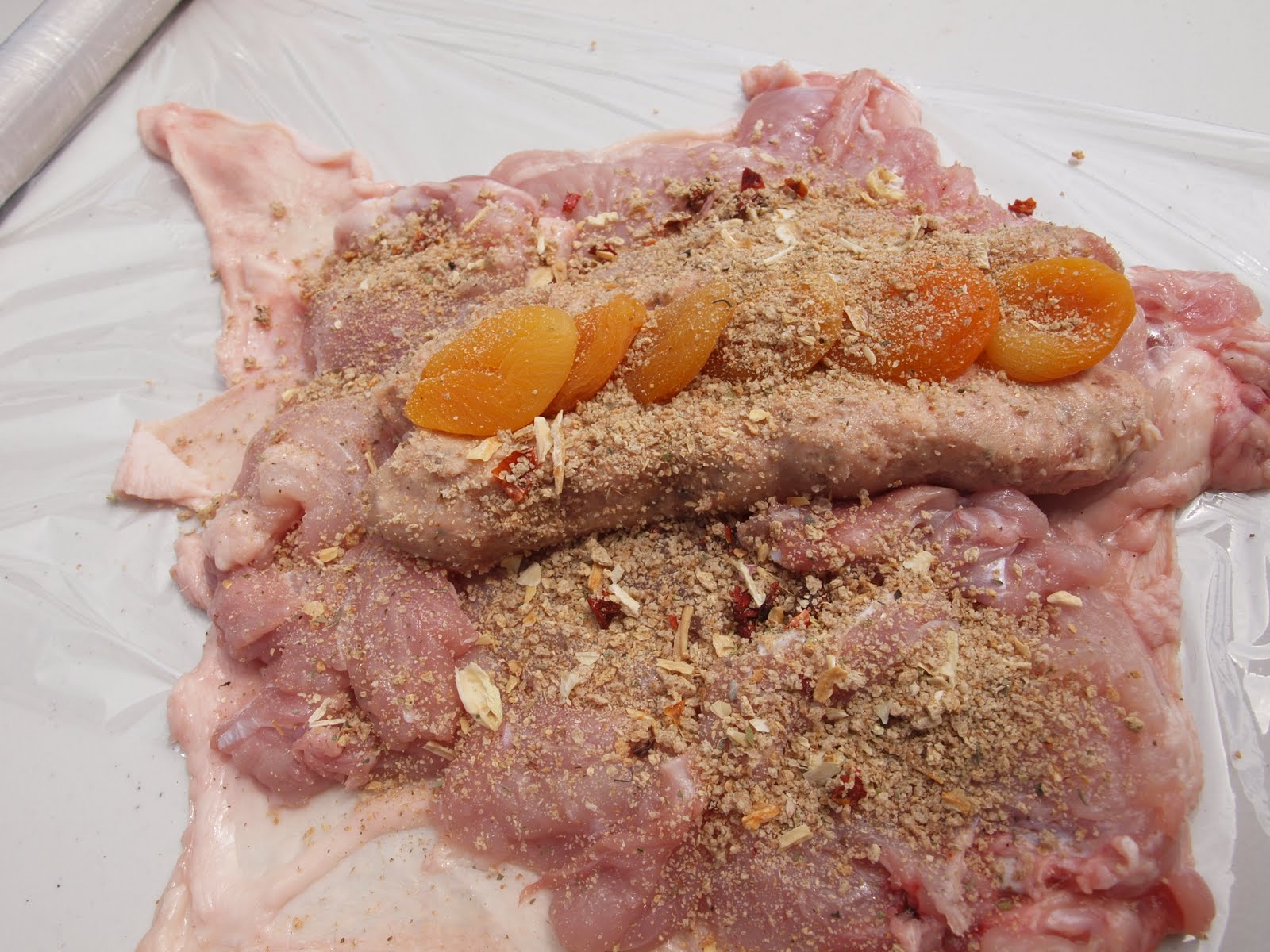
Take 4 of your favourite sausage and take the meat out of the skins.


Place 2 sausage onto the breast meat and fuse together using the back of a spoon allowing for the centre to be slightly hollow.


Place in the hollow a row of dried apricots and sprinkle some breadcrumbs and seasonings over the meats before applying the other 2 sausage on top.


Roll up and wrap your galantine in clingfilm before tying in twine.


A galantine of this size can be gently poached for 1 hour before unwrapping and browning in a skillet just prior to carving and serving. The dish also slices well when chilled and is a picnic favourite of mine when used as a cold dish.

Monday, 30 August 2010

Thuringer Mett


Thuringer mett (pronounced two-ringer met) has been a part of German food heritage for centuries and yet here in UK we would squirm at the thought of having it served at our table. What is it? you might ask, well I can tell you it is raw pork, minced and seasoned like any sausagemeat and served usually with raw onions and used like a pate on bread.

If you have ever visited Germany you will have noticed the strange toilets, the ones with an inspection shelf inside the pot, well this is because the Germans eat a lot of raw meats including pork of which can result in the passing on of worms that the animal may have been carrying.

There are many varieties of raw meat products which the Germans eat and Thuringer mett is just one of them. When this dish is served at a buffet it is usually served in a dish with a garnish of raw onion rings laid on top. Sometimes you will find the dish moulded to resemble an animal and a hedgehog seems to be a popular choice, probaly introduced to encourage the children to eat this dish.

Seasoning per kilo of meat:
16g x Salt
4g x Black Pepper

Guten Appetite!